The Morgan Silver Dollar coin is one of the most popular coins among collectors. Many investors have also taken an interest in Morgan Dollars, as they have increased in value significantly over time.
Designed by US Mint Engraver George T Morgan, the Morgan Series replaced the Barber in 1878 and was minted annually until 1904. No dollar coins would be minted again until 1921, when the Mint restarted minting $1 coins.
Morgan Dollars were in five different US Mint facilities: Philadelphia, San Francisco, Denver, Carson City, and New Orleans.
Morgan Dollars in cull or heavily worn and circulated condition can be found among junk silver. Even in cull condition, these coins command a premium over their melt value.
Morgan Silver Dollar History
The Morgan Dollar was created to support the mining industry. In the mid-1800s, Germany transitioned its economy from a bimetallic gold and silver standard to a gold standard while global demand and the price of silver were declining. By the mid-1870s, much of Europe, including the Latin Monetary Union, followed Germany onto the gold standard and stopped minting silver coins.
Silver and gold mining were major catalysts in the Westward Expansion of the United States, and the mining industry was critical to the country’s economic growth.
Several factors led to the drop in silver prices in the late 1870s. Germany and the LMU switched from bimetallism to a gold standard, and large silver deposits were discovered in western states. As such, with pressure from the mining industry, Congress developed the Bland-Allison Act.
The Bland-Allison Act required the Treasury Department to purchase between $2 million and $4 million worth of silver each month to be made into $1 coins. President Hayes initially vetoed the Act, but Congress overturned the veto and passed it into law in 1878.
Morgan Dollar Design
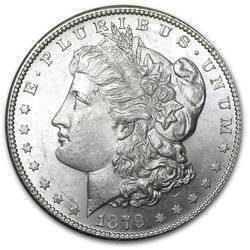
The obverse of the Morgan Dollar features a left-facing profile of Lady Liberty’s head. On her head is a Phrygian cap with the word “LIBERTY” inscribed. Inserted into the band of her cap are several agricultural elements, such as stalks of wheat, oak leaves, and cotton blossoms.
Above the portrait is the phrase “E PLURIBUS UNUM.” To the left of Lady Liberty are seven stars, and another six are to the right, representing the 13 original colonies. The year of minting is inscribed below the main portrait.
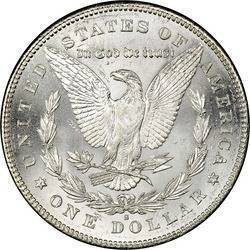
The Morgan Dollar reverse portrays a Bald Eagle facing to the left. The eagle’s wings are stretched wide. A wreath wraps around the bottom of the eagle. The eagle’s talons hold an olive branch in one, while the other has three arrows. The phrase “IN GOD WE TRUST” is inscribed above, with the denomination “ONE DOLLAR” inscribed below. “UNITED STATES OF AMERICA” wraps around the edge of the upper two-thirds of the coin.
What Was the Bland-Allison Act?
Passed in 1878, the Bland-Allison Act required the federal government to purchase between $2 million and $4 million worth of silver each month from domestic mines. The purpose of the act was to stimulate the U.S. silver industry and create bimetallic currency, circulating silver alongside gold. Despite President Rutherford B. Hayes vetoing the bill, it was overridden by Congress, reflecting the growing political pressure to support silver miners and populists who wanted an inflationary monetary policy.
The Bland-Allison Act directly led to the creation of the Morgan Dollar in 1878. To meet the monthly silver purchasing requirement, the U.S. Mint began producing large quantities of these new silver dollars. The act ensured a steady and significant demand for silver, leading to the mass production of Morgan Dollars over the next few decades.
How Many Morgan Silver Dollars Were Issued in the First Year?
In 1878, the first year of the Morgan Dollar, the U.S. Mint produced a total of approximately 10.5 million coins across multiple mint facilities. The coins from this year were issued with the following mint marks:
- Philadelphia (no mint mark): 10,508,000 coins
- Carson City (CC): 2,212,000 coins
- San Francisco (S): 9,774,000 coins
The Philadelphia Mint issued the most coins in 1878, but the Carson City Mint issues are particularly popular among collectors today due to their relatively lower mintage and the historical intrigue associated with the Carson City Mint.
Why Morgan Silver Dollars Are a Good Item for Prepping
Morgan Silver Dollars are highly regarded by collectors and investors, but they also offer several benefits for preppers that can be a useful addition to an asset portfolio.
Morgan Dollars are widely recognized, which makes them easy to trade or barter. Their historical significance and distinctive design provide a level of trust in their value during emergencies.
Each is composed of 90% silver and 10% copper, giving each coin approximately 0.7734 troy ounces of silver. The copper content increases the coin’s durability, preventing damage from wear and handling.
Morgans hold intrinsic value based on their silver content and can preserve wealth by offering both numismatic value and melt value.
As a physical asset, Morgan Dollars offer the benefit of being outside the banking system. They can serve as portable wealth with SHTF that can be used when other forms of payment are offline.