Mercury dimes were common in pocket change until the 1960s. After the US Mint changed the alloys used to mint dimes in 1965, many Mercury Dimes were pulled from circulation by collectors.
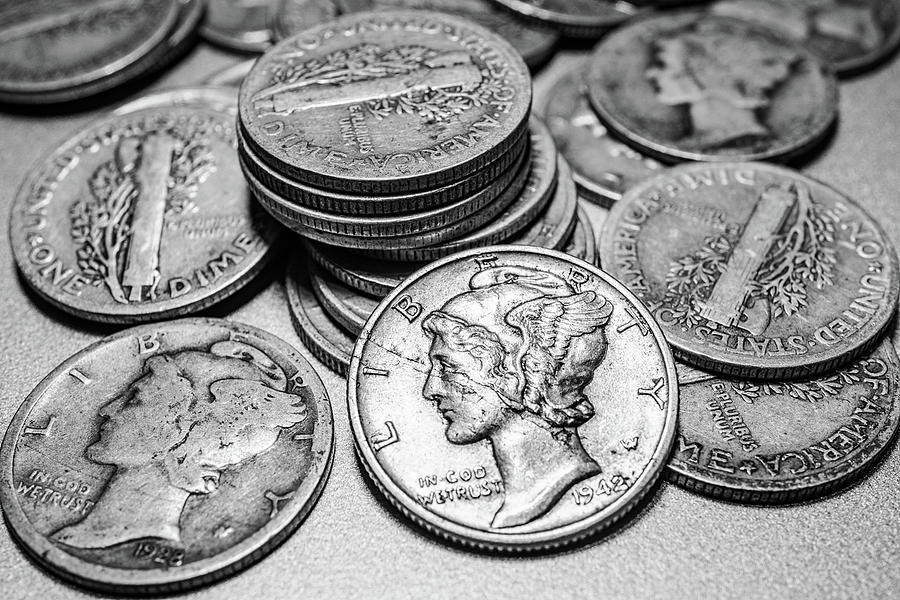
90% Silver Mercury Dime Highlights:
- Legal tender coinage produced by the US Mint from 1916-1945
- Face Value of 10 cents
- Mercury Dimes were common in circulation until silver was removed from circulated coinage in 1965
- Comprised of 90% silver, 10% copper
- Each dollar of face value contains about 0.715 troy ounces of silver
Mercury Dime Design
Sculpter Adolph Weinman is responsible for creating the design of the Mercury Dime. It is also commonly referred to as the Winged Liberty Head dime. It gained its common name due to the obverse depiction of a young Liberty wearing a winged Phrygian cap. It’s easy to confuse the cap with wings with the Roman god Mercury.
The Mercury Dime’s reverse depicts a fasces. A symbol of unity and strength, along with an olive branch to signify peace. The obverse contains inscriptions around the edge with the words “United States of America” and “ONE DIME”.
Why Stack Mercury Dimes?
As junk silver, Mercury Dimes can sometimes sell for a higher premium over silver Roosevelt Dimes. This is due to their being older, having generally less supply and many collectors looking for key dates. Some collectors and investors prefer Mercury Dimes and are happy to pay the slight premium.
There are 77 possible date and mint mark combinations of Mercury Dimes. A goal for many collectors is to put together a complete type set of all possible dates and mint marks. For those who have an interest in collecting, companies such as Whitman and Dansco make albums specifically for this purpose.
Most of the junk Mercury Dimes you will come across will show average wear from being in circulation for many years. Some may have partially or completely worn away dates and other features. This is perfectly normal. The value of these coins takes everyday wear and tear from circulation into consideration.
Silver Mercury Dimes are an excellent way to invest in silver. They have a deep history and there are many interesting aspects. If your goal is to stack junk silver as an investment or a store of wealth, 90% Silver Mercury Dimes are highly recognizable and make an excellent store of value.
Mercury Dime 1916-1945 Mintages by Mint Location and Year
| Year | Philadelphia (no mint mark) | Denver (D) | San Francisco (S) | Total Mintage |
|---|---|---|---|---|
| 1916 | 22,180,080 | 6,264,080 | 10,450,000 | 38,894,160 |
| 1917 | 55,230,000 | 9,402,000 | 27,330,000 | 91,962,000 |
| 1918 | 26,680,000 | 22,674,800 | 19,300,000 | 68,654,800 |
| 1919 | 35,740,000 | 9,939,000 | 8,850,000 | 54,529,000 |
| 1920 | 59,030,000 | 19,171,000 | 13,820,000 | 92,021,000 |
| 1921 | 1,230,000 | 1,080,000 | 0 | 2,310,000 |
| 1923 | 50,130,000 | 0 | 6,440,000 | 56,570,000 |
| 1924 | 24,010,000 | 6,810,000 | 7,120,000 | 37,940,000 |
| 1925 | 25,610,000 | 5,117,000 | 5,850,000 | 36,577,000 |
| 1926 | 32,160,000 | 6,828,000 | 1,520,000 | 40,508,000 |
| 1927 | 28,080,000 | 4,812,000 | 4,770,000 | 37,662,000 |
| 1928 | 19,480,000 | 4,161,000 | 7,400,000 | 31,041,000 |
| 1929 | 25,970,000 | 5,610,000 | 4,700,000 | 36,280,000 |
| 1930 | 6,770,000 | 3,940,000 | 1,860,000 | 12,570,000 |
| 1931 | 3,150,000 | 1,260,000 | 1,800,000 | 6,210,000 |
| 1934 | 24,010,000 | 6,772,000 | 7,150,000 | 37,932,000 |
| 1935 | 58,830,000 | 10,477,000 | 15,840,000 | 85,147,000 |
| 1936 | 87,500,000 | 16,132,000 | 9,210,000 | 112,842,000 |
| 1937 | 56,860,000 | 14,146,000 | 9,440,000 | 80,446,000 |
| 1938 | 22,190,000 | 5,537,000 | 8,090,000 | 35,817,000 |
| 1939 | 67,740,000 | 24,394,000 | 10,540,000 | 102,674,000 |
| 1940 | 65,350,000 | 21,198,000 | 21,560,000 | 108,108,000 |
| 1941 | 175,090,000 | 46,391,000 | 43,090,000 | 264,571,000 |
| 1942 | 205,410,000 | 60,740,000 | 49,300,000 | 315,450,000 |
| 1943 | 191,710,000 | 60,400,000 | 60,400,000 | 312,510,000 |
| 1944 | 231,410,000 | 62,224,000 | 49,490,000 | 343,124,000 |
| 1945 | 159,130,000 | 40,245,000 | 41,920,000 | 241,295,000 |
No Mercury Dimes in 1922
The early 1920s saw a post–World War I recession in the U.S. Following the sharp economic contraction of 1920–1921, there was reduced commercial activity and ample circulating coinage already in the system.
As a result:
- The U.S. Mint had a surplus of dimes from previous years.
- There was no need to strike additional dimes in 1922.
It’s worth noting that in 1922, no cents (Lincoln pennies) were minted at Philadelphia either—only Denver minted pennies that year. The Mint scaled back operations across multiple denominations.
No Mercury Dimes in 1932
1932 was deep within the Great Depression. Economic activity was severely depressed, and spending was drastically reduced. Specifically:
- The U.S. economy had extremely low transactional velocity, meaning coins circulated longer and wore out more slowly.
- Public demand for new coinage, including dimes, was at historic lows.
- Mint output was minimized to save government resources.
Instead of Mercury dimes, 1932 is known numismatically for the first year of the Washington Quarter, commemorating George Washington’s 200th birthday.